Unlocking Your Past: The Practical Power of a Genealogy Family History Workbook
We often think of genealogy as a sprawling, complex pursuit reserved for dedicated hobbyists with endless hours to spare. But the truth is, the desire to understand our roots touches nearly everyone at some point. You might find yourself after a family reunion, scribbling names and dates on a scrap of paper, wishing you had a better way to organize it. Or perhaps you’re listening to an older relative’s stories, feeling a pang of anxiety that these precious details will be lost. This is where a simple tool transforms a noble intention into a tangible project: a Genealogy Family History Workbook. It’s not just a book of blank pages; it’s a structured yet flexible framework designed to capture the chaos of memory and record into a coherent, lasting legacy.
A Framework for Your Family's Story
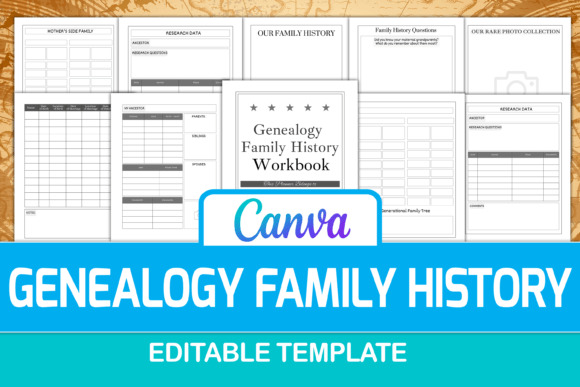
Imagine you’re finally ready to start. You have photos, a few old letters, and a head full of questions. Opening a standard notebook, you might jot down a grandparent’s name, but then stall—how do you structure the rest? A dedicated Genealogy Family History Workbook provides that essential scaffolding. It typically offers guided sections for direct lineages, individual profiles for key ancestors, places for photographs and documents, and prompts for personal anecdotes that go beyond birth and death dates. This structure removes the initial paralysis of “how to begin” and lets you focus immediately on the “what” – filling in the stories you already know.
The real beauty lies in its adaptability. While it provides order, it doesn’t impose rigidity. You can use it as a central repository for a deep, multi-generational project, or as a simple album for your immediate parents and grandparents. For many, it becomes a collaborative project. You might keep the workbook during holiday gatherings, inviting different relatives to contribute notes on their branch of the family. It becomes a physical object that sparks conversation and collective memory, something a digital file alone often fails to do.
Beyond the Personal Project: Creative and Professional Applications
The utility of a genealogy workbook extends far beyond the individual family historian. Consider the landscape of modern content creation and small business. Entrepreneurs, particularly in the “low-content” publishing space, recognize that tools which help others organize personal projects are in constant demand. A well-designed Genealogy Family History Workbook Canva Template, like the one described with its editable link and 120-page structure, is a powerful resource for these creators.
A blogger focusing on heritage crafts might use the template to create a custom workbook as a premium downloadable for their audience. A freelance graphic designer could quickly adapt it for a client wanting a bespoke family history album for a reunion gift. Educators, especially those teaching local history or sociology, might utilize the template to create a classroom project workbook, guiding students through interviewing family members. The provided flexibility—being able to add any Canva elements and tailor the design—means the core concept of the workbook can be molded to fit countless niches and audiences, not just generic genealogy.
What to Consider Before Starting Your Workbook Journey
Whether you’re using a workbook for your own family or adapting a template for a creative venture, a few practical considerations will shape your success. First, be honest about scope. A 120-page workbook is substantial. Are you aiming to fill it completely with a comprehensive tree, or would a simpler, shorter approach serve your immediate goal? Starting with a manageable goal, like documenting one grandparent’s life story, prevents the project from becoming overwhelming.
For creators using the template, think about your end-user’s experience. The template offers an 8.5×11 size with no bleed, making it ideal for straightforward home printing or professional print-on-demand services like KDP (Kindle Direct Publishing). Who is your target buyer? A person looking for a elegant, pre-designed workbook to gift, or a hobbyist who wants a basic structure they can scribble in? Your design choices within Canva—from font selection to the addition of decorative elements like vintage borders or modern minimalist icons—should reflect that user’s needs and aesthetic.
Finally, consider the medium of collaboration. If your workbook is meant to be a family heirloom, think about using it in a way that gathers input. Schedule a casual interview session with a relative, with the workbook open between you. The physical pages can make the process feel more like a shared activity than a formal interrogation. For the digital creator selling a workbook, providing clear instructions or suggestion prompts within the pages can greatly enhance its value, turning a simple template into a guided experience.
The Tangible Outcome of a Connected Present
At its core, working with a Genealogy Family History Workbook—whether filling it or designing it—produces something profoundly human: connection. The completed workbook is more than data; it’s a curated artifact. It becomes the document that future generations will reference, the book that finally gives your great-aunt’s pioneering journey a proper narrative home. It turns disconnected names on a chart into people with stories, occupations, and personalities.
For the entrepreneur, the outcome is a product that facilitates this connection for others. By offering a thoughtfully designed, editable template, you provide a tool that empowers people to undertake a meaningful project without needing technical design skills. You solve a real problem: the gap between wanting to preserve history and having a practical, beautiful system to do so. This aligns perfectly with the growing market for products that support personal well-being, creativity, and legacy-building.
So, whether you’re looking at a workbook sitting on your desk, waiting for your first entry, or you’re exploring a Canva template with the intent to create one for a wider audience, recognize the common thread. You’re engaging with a resource that bridges past and future. It organizes memory, inspires action, and ultimately, turns the intangible wealth of family history into something you can hold in your hands and pass on. That’s a practical power worth exploring.