The 2024 CBT Anxiety Journal Workbook KDP: A Practical Blueprint for Emotional Management
In the landscape of modern self-care and productivity, managing mental well-being is not a separate task but a foundational component of effective workflow. For professionals, creators, and anyone navigating the demands of daily life, anxiety can disrupt focus, drain energy, and stall progress. The 2024 CBT Anxiety Journal Workbook KDP represents a structured, process-oriented tool designed to integrate directly into this reality. It is not merely a book of prompts; it is an editable, customizable system built on Cognitive Behavioral Therapy (CBT) principles, engineered for practical implementation within your existing routines.
Where It Fits: Integrating Mental Tools into Daily Operations
Effective workflow management extends beyond task lists and calendars. It encompasses the cognitive and emotional space in which work happens. The 2024 CBT Anxiety Journal Workbook KDP serves as a specialized module within your broader personal or professional operating system. Think of your primary tools—project management apps, communication platforms, calendars—as handling the external logistics. This workbook addresses the internal logistics: the thought patterns, emotional responses, and physiological signals that can derail those external plans. Its inclusion of elements like a 2024 Calendar, Monthly Goal Planning, and Weekly Task Planning allows it to function in parallel with your other planning tools, providing a holistic view that links objectives with the mental state required to achieve them.
For instance, a freelancer planning a quarterly project can use the Monthly Goal Planning section to outline deliverables, while simultaneously employing the Weekly Self Care Tracker and Mood Tracker to ensure sustainable energy levels. An educator preparing a new curriculum can utilize the Weekly Task Planning alongside the Tension Check-in to manage stress during intensive preparation phases. This synchronous use prevents well-being practices from becoming an isolated, neglected activity; they become documented, tracked components of the execution process.
The Core Mechanism: Editable CBT Interiors for Personalized Workflows
The standout feature of the 2024 CBT Anxiety Journal Workbook KDP is its editable nature via a provided Canva link. This transforms it from a static product into a dynamic asset. Customization is key to integration. A rigid tool often fails because it does not conform to the user’s unique process. Here, the workflow is adaptable. You can adjust sections, rename headings, or emphasize certain trackers based on your specific challenges.
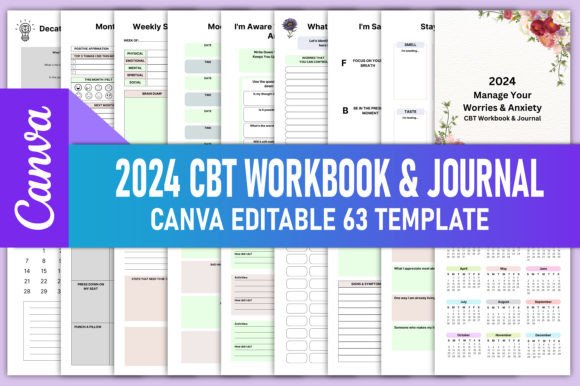
Consider the **Decatastrophizing** and **Review Your Thought Patterns** pages. These are core CBT exercises for challenging cognitive distortions. In a practical workflow, these can be scheduled—perhaps during a weekly review session after assessing project hurdles. If your anxiety manifests more physically, you might prioritize customizing the **Physical Coping Skills for Anger Management** and **Hearth Breathing** sections, placing them earlier in your daily digital journal sequence. The editable files mean a small business owner can integrate branding or add company-specific wellness goals into the **My Vision Board** or **Monthly Reflections**, making the tool a seamless part of their organizational culture.
Operationalizing CBT Strategies: From Concepts to Daily Actions
The workbook translates theoretical CBT techniques into actionable, logged items. This is critical for individuals who value measurable progress and consistency. For example:
- The Balloon Mental Exercise and Hexagon Breathing are brief, scripted interventions. They can be deployed as "pre-work" rituals before a high-stakes meeting or creative session, logged in the Bedtime Reflection to assess their efficacy.
- Worry Coping Cards function as quick-reference guides. Their utility in a workflow is akin to having a troubleshooting manual; when a worry about a client's feedback or a marketing campaign's performance arises, the cards provide a structured response protocol, interrupting the unproductive thought cycle.
- Monthly Health Check-In and Medication Tracker offer longitudinal data. This supports quality control over your health management strategy, allowing you to correlate mental state trends with productivity outputs over months, informing future planning.
This design ensures that coping mechanisms are not forgotten ideas but are recorded, practiced, and refined as part of a continuous improvement loop.
Implementation in Specific User Workflows
The application varies naturally across the target audience, fitting into different stages of projects and routines.
For Creators and Entrepreneurs
The creative and business development process is inherently uncertain, triggering anxiety. The workbook can be used before launching a new product or content series. Utilizing the My Vision Board and Positive Affirmations sections solidifies intent and combats doubt. During the execution phase, the Weekly Task Planning paired with the Stay Grounded and I'm Safe In My Body exercises maintains focus amidst setbacks. After a project completion, the Monthly Reflections and Gratitude Bucket facilitate a constructive post-project review, preventing burnout and anchoring lessons learned.
For Educators and Professionals in High-Stakes Roles
Preparation and performance periods are critical. Here, the workbook acts as a preparedness tool. The Physical Activities Tracker and Self Care Checklist ensure foundational well-being is maintained during intensive periods like exam marking or fiscal quarter closes. The Appointment Tracker integrated with What Will Make Today Great prompts transforms a simple schedule into an intentional daily plan. The 30 Days Self Care Challenge can be initiated prior to a known stressful period, building resilience proactively.
For Hobbyists and Productivity-Minded Individuals
Even personal goals require management. Learning a new skill or managing a home project introduces anxiety. The Monthly Goal Planning for the hobby, tracked alongside the Positive Journaling entries, links progress to positive reinforcement. The Weekly Dream Journal might reveal anxieties about capability that can then be addressed using Things I… prompts for cognitive restructuring.
Long-Term Integration and Usability Considerations
For a tool to endure, it must be organizationally efficient and compatible with long-term use. The 2024 CBT Anxiety Journal Workbook KDP, delivered as high-quality, print-ready PDFs, offers multiple integration paths. You can print it as a physical companion to your other planners, use the PDFs digitally on tablets with note-taking apps, or customize and export specific pages from Canva for use in digital dashboards. The consistent structure across months—with recurring trackers and check-ins—promotes habit formation, reducing the cognitive load of starting fresh each week.
The Specification Belongs To page and clear section demarcation enhance usability. You don’t waste time navigating; you open the tool and execute the relevant exercise. This efficiency is vital for busy users who cannot afford cumbersome wellness practices. The workbook’s design acknowledges that the process of managing anxiety must itself be low-friction to be sustainable.
Key Factors for Successful Adoption
- Preparation: Spend time in Canva initially tailoring the workbook. Align it with your known stressors and existing planning tools. This upfront investment ensures compatibility.
- Consistency: Anchor its use to an existing ritual—your morning coffee review, your weekly Sunday planning session, or your evening shutdown routine.
- Review: Treat the Monthly Check-In and Monthly Reflections as data analysis points. What patterns emerged between your mood and productivity? Adjust your approach in the next month accordingly.
Ultimately, the 2024 CBT Anxiety Journal Workbook KDP is more than an interior file for KDP publishing. It is a operational manual for the mind, designed for those who approach their growth—professional and personal—with intention and systematic effort. By embedding CBT's evidence-based techniques into a flexible, trackable framework, it allows you to manage anxiety not as a disruptive outlier, but as a variable within your controlled process, leading to greater consistency, improved quality of output, and sustained personal effectiveness.